Some links below are affiliate links — if you buy through them, No-Money Music may earn a small commission at no extra cost to you (full disclosure). We only point to gear we’d actually use. Every price on this page was read off the product’s own Amazon page on 22 September 2026 — prices move, so check before you buy.
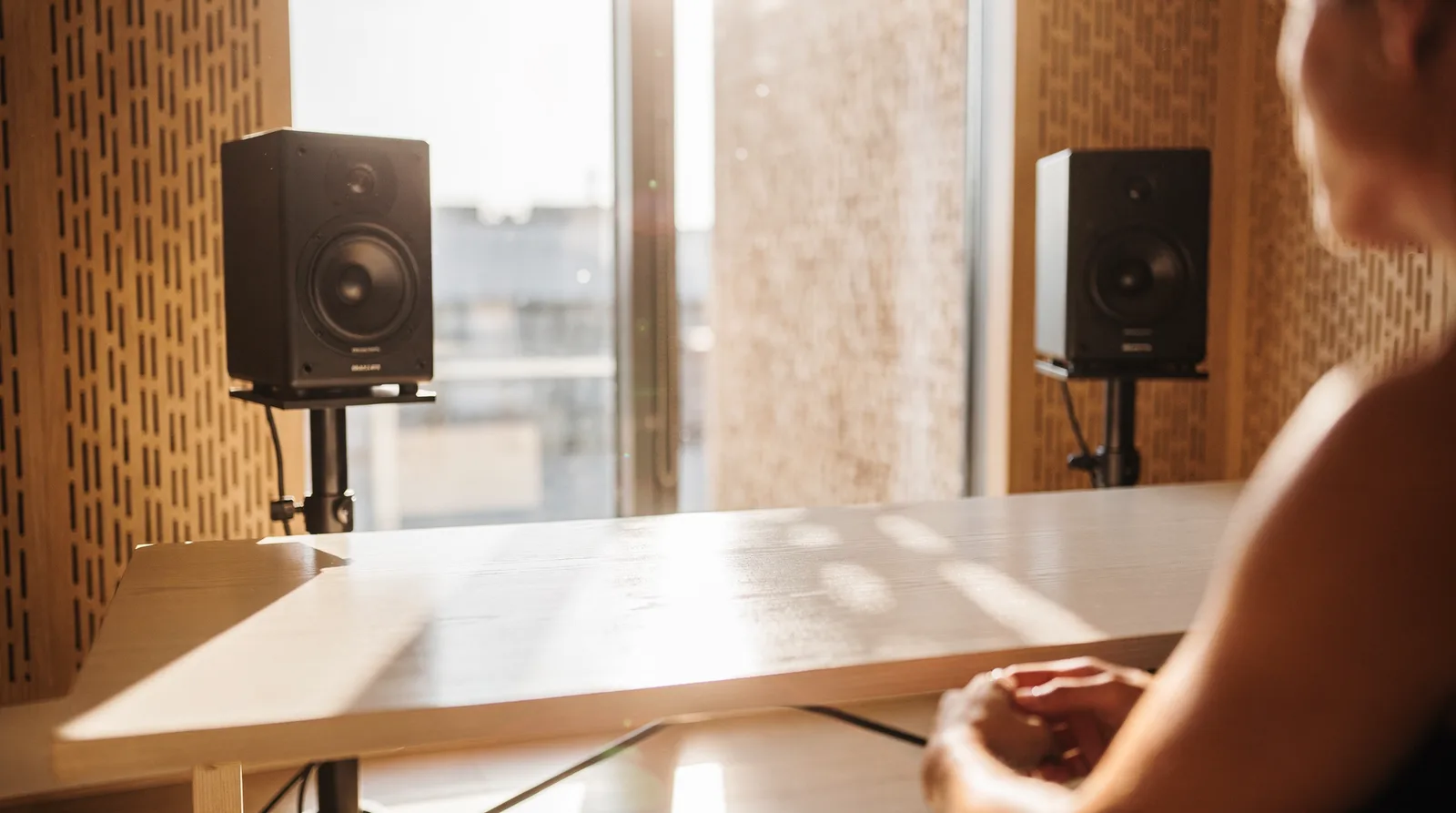
Speakers sitting flat on a desk are lying to you about bass. Not a little — enough that you will mix the low end wrong and hear it in the car. This is the cheapest genuine improvement available to a home studio, and the first version of it costs nothing.
What is actually going wrong
Two things, both physical. A speaker bolted to a desk transmits vibration into the desk, and the desk becomes a second, worse speaker — that is the boom. And a desk surface reflects sound back up into your ears a few milliseconds after the direct sound, which cancels specific frequencies and leaves holes you will mix into.
Neither is fixed by better speakers. Both are fixed by lifting the speakers up, tilting them at your ears, and decoupling them from the surface.
The $0 way: books, and a tape measure
Stack hardback books under each speaker until the tweeter — the small top driver — is level with your ears when you are sitting normally. This is the single largest change, and it is the one everyone skips. Tilt them down slightly if they end up above ear height.
Then three placement rules: pull them at least 8 inches off the wall behind them (bass builds up against walls); make an equilateral triangle — the distance between the two speakers should equal the distance from each speaker to your head; and keep them symmetrical in the room, because one speaker in a corner and one in open space will never balance no matter what you do in the mix.
Books work. A folded towel under each one does most of the decoupling. Do this today before you spend anything, and listen to a song you know well.
The cheap pick
The Auralex MoPAD studio monitor isolation pads ($45.19) are wedges of dense foam that decouple the speaker from the desk and let you angle it up or down. This is the purchase that does what the towel does, but properly and repeatably, and it will still be doing it in ten years because there is nothing in it to break.
Do the book version first anyway. If lifting the speakers to ear height did not change what you heard, the pads will not either, and you have saved the money.
The buy-once pick, which is not what you expect
If your room is small, square, shared, or has the desk against a wall you cannot move, the honest answer is that no stand fixes it. At that point the better purchase is a pair of closed-back headphones you can trust: the Audio-Technica ATH-M20x ($59.00) is the most-used reference headphone in home studios for a reason, and it removes the room from the decision entirely.
Mixing on headphones is not a compromise any more. Check the balance on any other speaker you own before you call it done, and you are fine.
What nobody needs
Foam panels stuck behind the speakers — thin foam absorbs treble and leaves the bass problem completely untouched, which makes the room duller without making it more accurate. Isolation “feet” at $80 a set. And new monitors, when the old ones have never once been raised to ear height.
Tweeters at ear height, 8 inches off the wall, equilateral triangle. Books will do it tonight. If that changes nothing, pads will not either.
Three pages on this site that carry it further: The resources list · The best budget studio monitors · How to treat a bedroom studio cheaply.
Want the Whole Blueprint?
Gear is one piece. The step-by-step system for building a music career with no budget lives in the workbook.