Some links below are affiliate links — if you buy through them, No-Money Music may earn a small commission at no extra cost to you (full disclosure). We only point to gear we’d actually use. Every price on this page was read off the product’s own Amazon page on 22 September 2026 — prices move, so check before you buy.
You do not need an amp, a microphone, or a treated room to record an electric guitar that sounds like a record. You need a cable and a plugin. Here is the whole ladder, from nothing to the one purchase worth making.
The $0 way: plug straight in and let software be the amp
A guitar pickup puts out a signal your computer can already read. Plug the guitar into whatever input your machine has — a headphone/mic combo jack, an old USB adaptor, anything — record the dry, ugly, direct signal, then put an amp simulator on the track. The simulator does what a cranked amp and a microphone in a good room would have done, and it does it after the fact, at 2am, without a neighbour hearing anything.
Every major DAW ships with one. Logic has Amp Designer. GarageBand has the same engine. Reaper, Cakewalk and Waveform all read third-party plugins, and Amplitube CS, Guitar Rig Player and Ignite Amps' Emissary cost nothing to download. That is a complete electric guitar rig for the price of a cable you probably already own.
The part nobody tells you: record the dry signal, not the processed one. If you keep the untouched direct track, you can change the amp, the cabinet and the room three weeks later when you decide the tone was wrong. If you record through the amp sim, that decision is welded to the take forever.
Why it usually sounds bad the first time
Two reasons, both fixable in a minute. Input level: a guitar is a weaker signal than a microphone, so if your input has a gain knob, push it until the loudest strum peaks around −12 dB — not near zero. Impedance: a guitar pickup wants a high-impedance (Hi-Z) input. Plugged into a line-level or mic-level input it goes thin and brittle, and people blame the plugin. That thinness is the single thing an interface actually fixes.
The cheap pick, when the dry signal is the problem
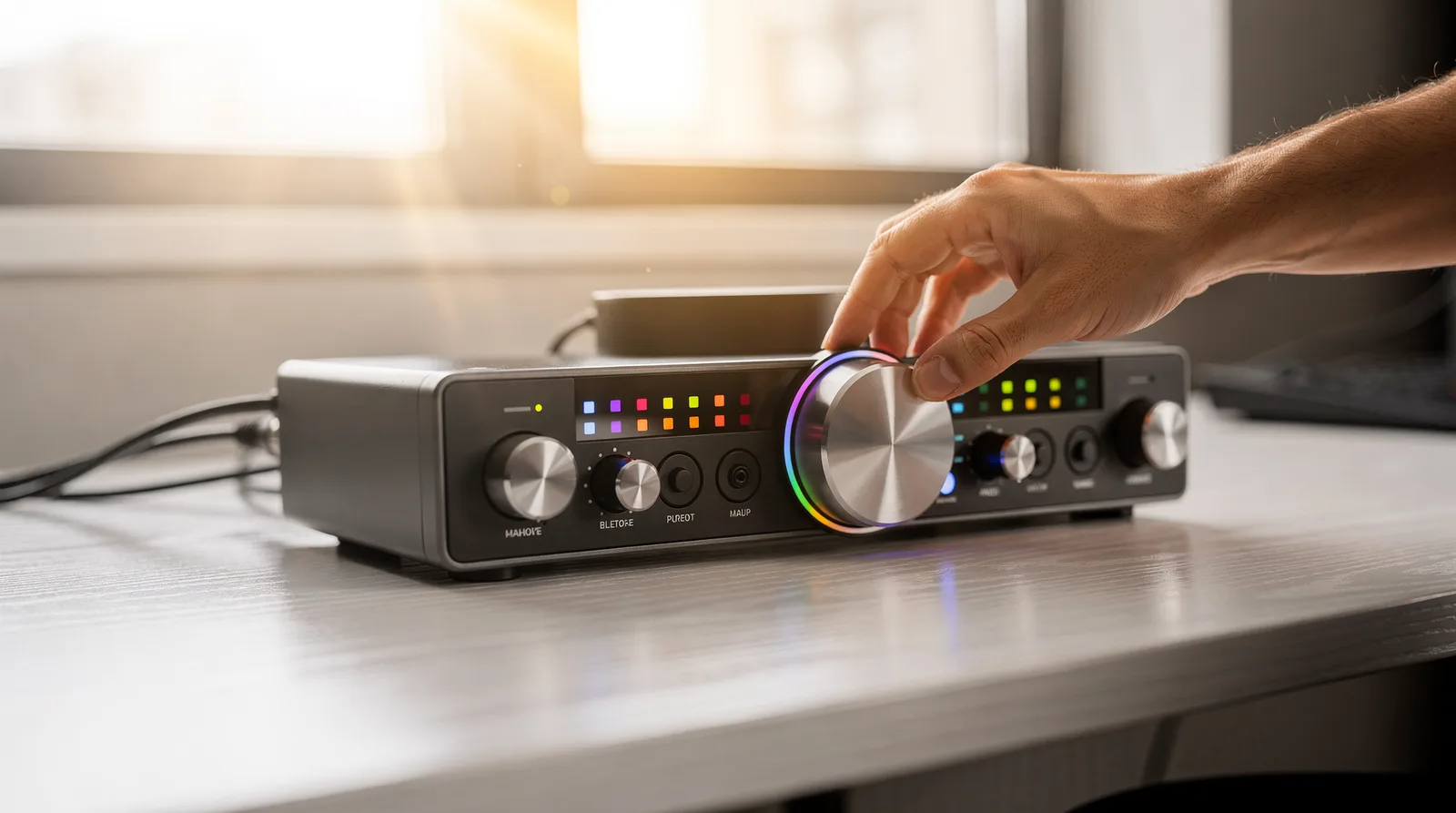
The M-Audio M-Track Solo ($49.00, in stock on the day this was written) is the cheapest box I would put between a guitar and a computer. It has a real instrument/DI input, so the pickup sees the load it expects, and it ships with recording software. That is the entire upgrade — you are buying a correct input, not a better sound.
If you write on a phone or an iPad instead of a laptop, the IK Multimedia iRig 2 ($39.99) does the same job for less, and it is the reason a lot of demos start in a hotel room.
The buy-once pick
The Focusrite Scarlett Solo 4th Gen ($159.99) has a dedicated Hi-Z instrument input, a microphone preamp for when you eventually want to sing or mic a cab, and it will still be working in ten years. Buy this one when you are recording weekly, not before — and note the real price. This site has quoted the Solo at around $130 in the past; on the day this page was written it was $159.99, which is the kind of drift worth checking yourself.
What nobody needs
A reamp box. A tube preamp. A $300 hardware modeller. A pedalboard to record with. None of these fix the two problems above, and all of them are bought by people whose actual issue was an input level set too low. The order that matters is: playing, then the part, then the tone. Gear is last, and it is smaller than it looks.
Plug in dry, put a simulator on it, keep the dry track. If the tone is thin, it is your input impedance, not your plugin — and that is the one thing $49 fixes.
Three pages on this site that carry it further: The resources list · Recording software that costs nothing · The best audio interface for beginners.
Want the Whole Blueprint?
Gear is one piece. The step-by-step system for building a music career with no budget lives in the workbook.