Some links below are affiliate links — if you buy through them, No-Money Music may earn a small commission at no extra cost to you (full disclosure). We only point to gear we’d actually use. Every price on this page was read off the product’s own Amazon page on 22 September 2026 — prices move, so check before you buy.
The phone in your pocket has a better microphone, a better converter and more processing power than the studio that recorded most of the records you grew up on. The reason phone recordings sound bad is almost never the phone.
The $0 way, and it is genuinely enough
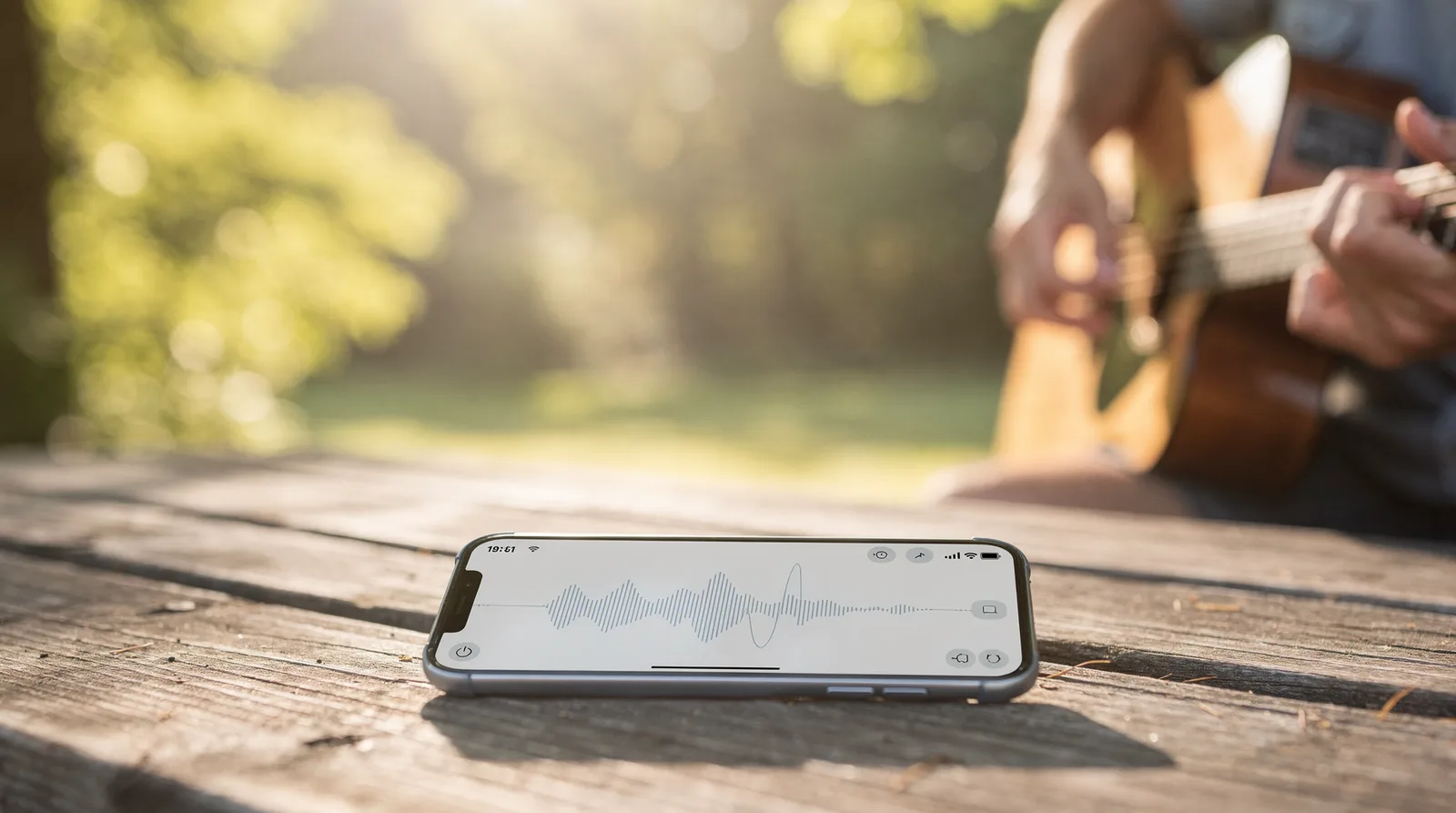
Voice Memos on iPhone, Recorder on Pixel, and BandLab or GarageBand on either platform will all capture a song you can release. BandLab gives you multitrack, a browser-based mastering pass and a way to share a link, all at no cost. GarageBand on iOS is a full DAW with a real mixer.
The settings that actually matter, in order: turn on airplane mode (a notification lands in the middle of the best take every single time), take the case off if it covers the bottom microphone array, and stop holding the phone. Hand noise is the loudest thing in most phone recordings. Lean it against a mug.
Distance is the whole game
Phone microphones are omnidirectional and heavily processed for speech. They are tuned to assume you are talking at them from a foot away, which means they fight you when you put them too close to something loud. For a singer with a guitar, put the phone about 18 inches away, level with your sternum — not on the table in front of you, where it hears the table.
If the vocal is swamping the guitar, move the phone down. If the guitar is swamping the vocal, move it up. You are mixing by moving a phone, and it works better than any plugin will on a finished stereo file.
The one-take method
Record the song five times in a row without listening back once. Then listen to all five. Take four is almost always the one — late enough that you have stopped performing at the microphone, early enough that you have not started getting tired of the song. This costs nothing and improves more recordings than any purchase on this page.
The cheap pick
If you want a guitar or keyboard into the phone rather than in front of it, the IK Multimedia iRig 2 ($39.99) takes an instrument cable in and gives you a headphone output for monitoring. It is the smallest complete rig that exists.
The buy-once pick
The Audio-Technica AT2020USB-X ($168.00) connects straight to a modern phone over USB-C with no interface and no adaptor, and it is the same capsule studios put in front of voiceovers. It is the point where a phone recording stops sounding like a phone recording. It is also the most expensive thing on this page, and you should get to take four on the built-in microphone before you consider it.
What nobody needs
A gimbal. A ring light. A “podcast kit” built around a phone clamp. A lav microphone for music — they are voice tools and they flatten instruments. If you are recording sound, spend on the thing closest to the sound, and the phone is already there.
Airplane mode, case off, 18 inches away, take four. That sequence costs nothing and fixes more phone recordings than any purchase on this page.
Three pages on this site that carry it further: The resources list · How to record music with no money · The best handheld recorder for songwriters.
Want the Whole Blueprint?
Gear is one piece. The step-by-step system for building a music career with no budget lives in the workbook.