Some links below are affiliate links — if you buy through them, No-Money Music may earn a small commission at no extra cost to you (full disclosure). We only point to gear we'd actually use.
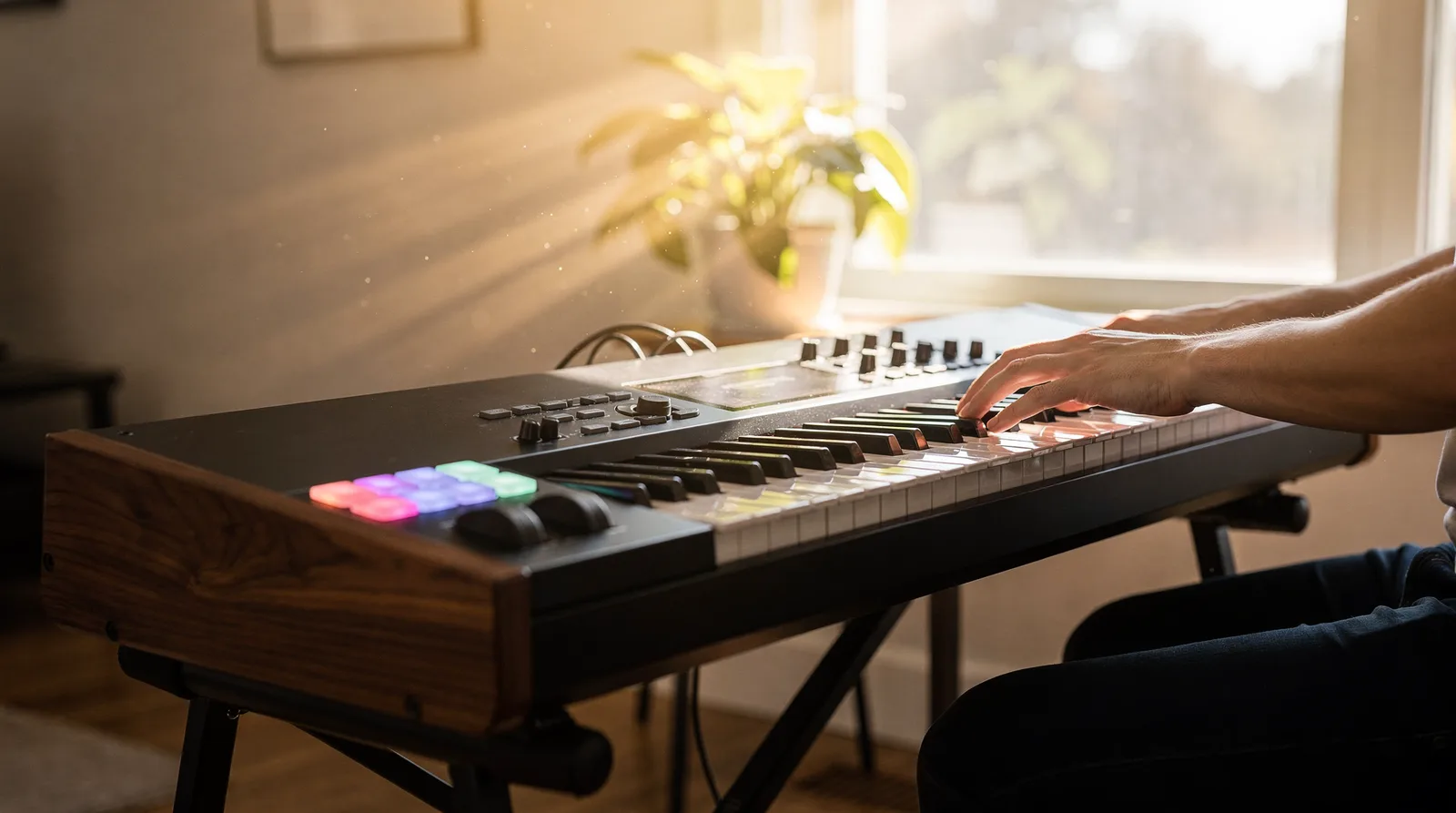
A MIDI keyboard is the fastest bridge between the idea in your head and a recorded part. It turns your laptop into a piano, a string section, a synth, a drum kit — anything your software can make. And the best one for starting out costs about a hundred bucks. Here's the honest pick.
First, what it actually is
A MIDI keyboard makes no sound on its own. It's a controller — it tells the instruments inside your software what to play. That's why even a cheap one is powerful: the sounds come from your computer, and there are thousands of free ones.
Keys, pads, or both?
Keys are for melodies, chords, basslines. Pads are for finger-drumming beats. Most beginners want both — and the good news is the popular starter controllers include both.
How many keys?
25 mini keys is plenty for beats and one-handed parts, and it fits on any desk. Step up to 49 keys only if you actually play piano with two hands. Don't pay for 88 keys you won't use yet.
The picks
The Akai MPK Mini MK3 (~$119) is a common starter controller — keys, pads, knobs, and a software bundle to start today. The Arturia MiniLab 3 (~$109) feels premium and ships with a huge sound library. Want full-size keys? The M-Audio Keystation 49 (~$99). Living in Ableton? The Novation Launchkey Mini (~$109).
What I'd actually buy: the Akai MPK Mini MK3. It's the one most producers start on, it does everything you need to learn, and the bundled software gets you making music the day it arrives.
Plugging it in is easy — most run straight over USB. If you're also recording mics or guitar, you'll want an audio interface too.
Want the Whole Blueprint?
Gear is one piece. The full step-by-step system for building a real music career with no budget lives in the free workbook — and every pick above lives on the free tools page.