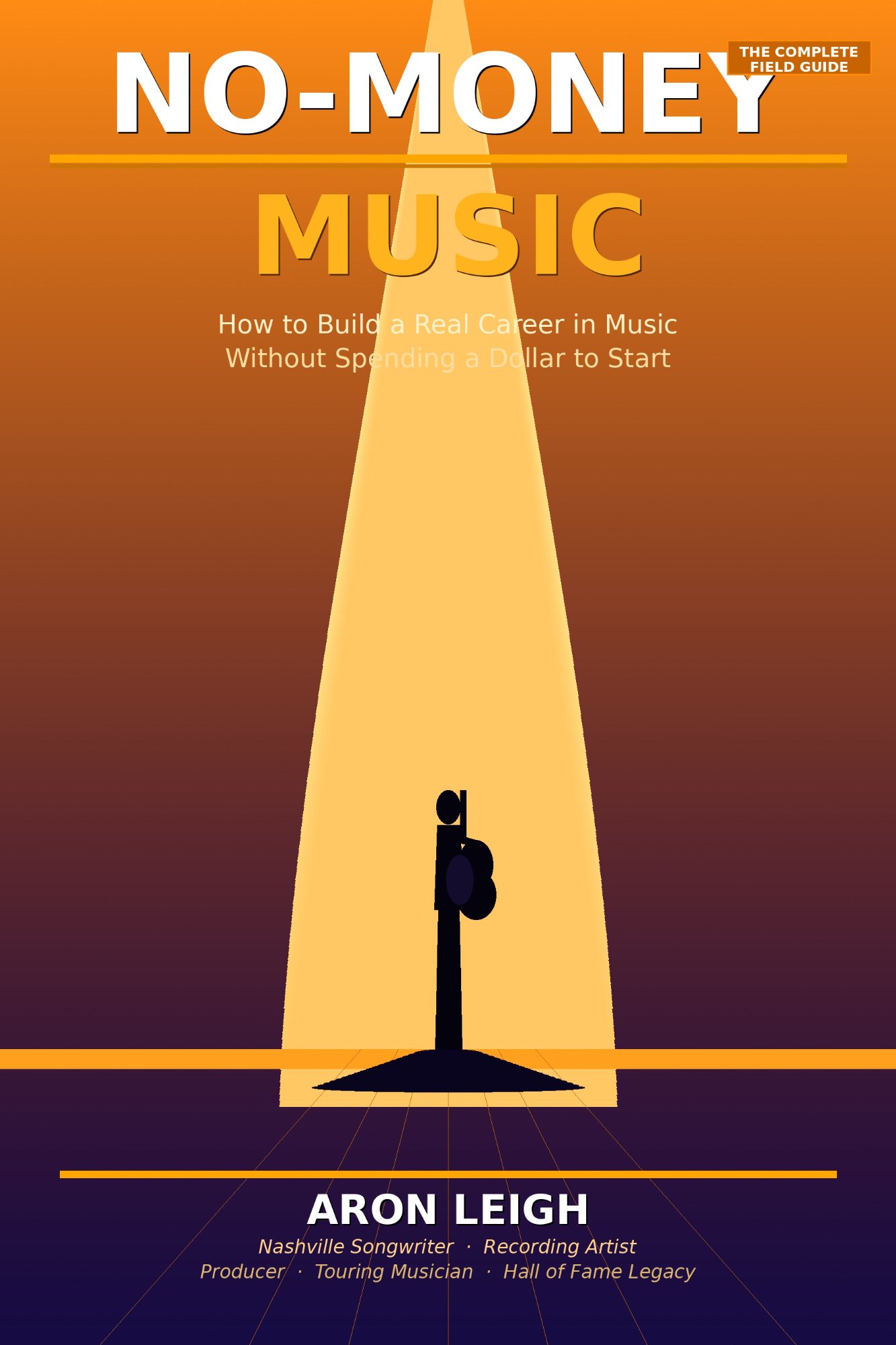
Meet Jordan.
Jordan is seventeen years old, living in a two-bedroom apartment with his mom and younger sister in Memphis, Tennessee. He has no car, no job, no recording equipment, and no connections in the music industry. What he has is a phone — a mid-range Android he got for his birthday — a pair of earbuds with a built-in mic, and a feeling he can't shake: that music is the thing he's supposed to be doing with his life.
Most people would tell Jordan to be realistic.
We're here to tell you that Jordan — right now, today, with exactly what he has — can begin building a legitimate music career. Not a fantasy. Not a "maybe someday." A real one. This chapter is about why that's true, and how it works. Not just for Jordan. For you.
Let's clear something up before we go any further, because the title of this book tends to make people assume the wrong thing. No-Money Music is not about being broke. It is not about making cheap-sounding music or operating from a place of scarcity. It is not a consolation prize for people who can't afford the "real" path. No-Money Music is about leverage.
It means understanding that the tools required to build a music career are now, for the first time in history, available to almost anyone with a phone and an internet connection. It means learning to use those tools intelligently — replacing dollars with knowledge, relationships, skill, and strategic effort.
Think of it this way. Two people want to cross a river. One person has a motorboat. The other has a kayak and knows how to use it expertly. The motorboat person might get across faster at first. But if the motor breaks, if the fuel runs out, if the river gets narrow — the kayaker adapts and survives. No-Money Music teaches you to be the kayaker.
Money is useful in music. We are not going to pretend otherwise. Later in this book, we'll talk about when and how to spend money strategically if and when you have it. But money is not the starting point. It never has been for the greatest artists in the world, and it won't be for you.
Knowledge is the starting point. Action is the engine.
Consistency is the fuel.
Here it is. The single most damaging belief in music: "I'll start when I have better equipment." You've probably said a version of this. Most people have.
Maybe yours sounds like: – "I need a real microphone first." – "Once I save up for studio time, I'll be ready." – "My music isn't ready to share yet." – "I need to take more lessons before I put anything out." These statements feel like wisdom. They sound like patience and preparation. But in most cases — not all, but most — they are avoidance wearing a disguise.
Consider the story of Chance the Rapper. In 2012, Chance was a high school junior in Chicago who had just been suspended for ten days. He used that suspension to record a mixtape in his friend's basement. No major label. No professional studio. No budget. He uploaded it to the internet for free and gave it away.
That mixtape — 10 Day — launched one of the most remarkable careers in modern music history. He eventually won three Grammy Awards, all without ever signing to a major label. Was his basement setup perfect? No. Was the recording professional-quality by industry standards? Not particularly. Did it matter?
It did not matter at all.
What mattered was that he started. What mattered was that he finished something and put it into the world.
Closer to home, consider what happens when aspiring artists wait. We've watched talented people sit on music for years — genuinely gifted people — waiting for the right moment that never arrives. Meanwhile, people with less natural ability but more willingness to act build audiences, release music, make mistakes, learn from them, and grow. The ones who waited are still waiting. The ones who acted have careers.
Momentum creates opportunity. Not the other way around.
To understand why No-Money Music is possible today, it helps to understand how impossible it would have been fifty years ago. In 1975, if you wanted to record a song, you needed to book time at a professional recording studio. A single hour in a decent studio could cost anywhere from fifty to several hundred dollars — and in today's money, that's far more. You needed engineers, sometimes session musicians, and the technical knowledge to communicate what you needed. If you wanted your music distributed nationally, you needed a record label with physical distribution relationships. If you wanted people to hear it, you needed radio airplay, which required label relationships and payola knowledge that most artists never had access to.
The barriers weren't just financial. They were structural. The industry was a closed system, and the gatekeepers controlled every door.
Now look at what exists today: Free recording software — tools like BandLab, GarageBand, and Cakewalk are available at no cost and are genuinely powerful.
BandLab works directly in your phone's browser. GarageBand comes pre-installed on every iPhone and iPad. These are not toy programs. They are professional-grade tools that musicians have used to create commercially released music.
Global distribution for almost nothing — platforms like DistroKid, TuneCore, and others will put your music on Spotify, Apple Music, Amazon, Tidal, and dozens of other platforms for as little as twenty dollars a year.
Direct access to fans — TikTok, Instagram, YouTube, and SoundCloud allow you to reach millions of potential listeners without spending a single dollar on promotion. Olivia Rodrigo's breakthrough was partially driven by TikTok. Billie Eilish built her initial fanbase through SoundCloud when she was thirteen years old, recording in her bedroom.
Free education — YouTube alone contains more music education than any music school in the world. You can learn music theory, mixing, songwriting, vocal technique, music business, and more without paying for a single class.
AI assistance — we are living through one of the most significant creative technology shifts in history. Artificial intelligence tools can now help with everything from songwriting prompts to production suggestions to marketing content. Used well, AI removes even more barriers for independent artists.
The barrier to entry has collapsed. What used to require thousands of dollars and industry connections can now be done from a phone in a bedroom.
This is not hype. This is the current reality of the music industry, and it is the foundation that this entire book is built on. We are not going to give you a list and move on. We are going to explain exactly what each tool does and why it matters, because one of the biggest problems we see is people who have heard of these tools but don't fully understand how to use them.
BandLab — bandlab.com BandLab is a free online DAW. DAW stands for Digital Audio Workstation — it is the software you use to record, edit, arrange, and produce music. Think of it as your digital recording studio. What makes BandLab exceptional for No-Money musicians is that it runs directly in your web browser and on your phone. You do not need a powerful computer. You do not need to download anything. You open it, and you start recording.
BandLab includes multi-track recording (meaning you can record multiple instruments or vocals separately and combine them), virtual instruments, audio effects like reverb and compression, basic mixing tools, and cloud storage so your work is always saved and accessible from any device.
A seventeen-year-old in Memphis with a phone and earbuds can open BandLab right now and record a song. That is not a metaphor. That is literally what the tool allows.
GarageBand — Pre-installed on all Apple devices If you have an iPhone, iPad, or Mac computer, you already have GarageBand. It came with the device. Most people have never opened it.
GarageBand is more powerful than many people realize. It contains hundreds of software instruments, a complete recording environment, loops, effects, and mixing capabilities. It has been used to record songs that appeared on major label albums. It is the tool that countless professional artists started with.
If you have an Apple device and haven't opened GarageBand yet, open it today.
Cakewalk by BandLab — bandlab.com/products/cakewalk Cakewalk is for Windows computers and is one of the most interesting stories in music software history. It was originally a professional paid DAW that cost hundreds of dollars. The company that made it shut down. BandLab acquired it and made it permanently free.
Cakewalk now offers features comparable to software that professional studios pay significant money for. If you have a Windows PC, Cakewalk is one of the most powerful free tools available to you.
Audacity — audacityteam.org Audacity is a free audio editor that has been around for over twenty years. It is less focused on music production and more on recording and editing audio — recording vocals, cleaning up recordings, cutting and arranging audio clips.
It is an excellent companion tool. Record your rough idea in BandLab or GarageBand, then use Audacity to clean it up, trim it, or prepare it for export.
Your Phone's Native Voice Recorder This is the most overlooked tool on this list, and in some ways the most important one.
Every great songwriter will tell you that ideas are fragile. They arrive without warning — in the shower, on the bus, in the middle of the night — and they leave just as fast if you don't capture them.
Your phone's built-in voice recorder is your most important weapon against losing ideas.
Record every melody that comes to you. Every lyric fragment. Every rhythm your mouth makes. Don't judge it. Don't polish it. Just capture it. You will return to these recordings and find gold that you would have completely forgotten otherwise.
Let's spend a moment on this because it holds a lot of people back. Many aspiring artists believe that without a professional microphone — ideally something in the $200-500 range — their recordings will sound too amateur to share. This belief keeps them from recording anything at all.
Here's what's actually true: modern phone microphones are significantly better than most people assume. The microphone in a current-generation iPhone or mid-range Android captures audio that would have been considered impressive studio quality fifteen years ago. The earbuds that came with your phone have a built-in microphone that works for vocal recording.
Are these tools as good as a professional microphone in a treated recording room? No. But that is not the question. The question is whether they are good enough to capture your ideas, build your skills, connect with an audience, and create real music. The answer to that question is yes.
Billie Eilish recorded her breakthrough song "Ocean Eyes" when she was thirteen, in her brother Finneas's bedroom. The setup was simple. The emotion was real. The song changed her life. The equipment ceiling for getting started is much lower than the music industry wants you to believe. We'll talk about when upgrading equipment actually makes sense later in this book. For now, use what you have.
Here is something the big music books don't spend enough time on: organization is one of the most underrated skills in building a music career.
Artists who stay organized consistently outpace artists with more talent who don't. Why? Because disorganization destroys momentum. When you can't find your lyrics file, when you lose a recording because you didn't back it up, when you forget which version of a song you were working on — you waste time, lose energy, and start to feel like you're not making progress even when you are.
The good news is that free tools handle this completely. Google Drive (drive.google.com) gives you fifteen gigabytes of free cloud storage. Create folders for each song, each project, each stage of your career. Every lyric goes in there. Every recording. Every contract or agreement you ever sign. If your phone breaks tomorrow, your work survives.
Notion (notion.so) is a free organization platform that many professional musicians and business people use. Create a simple system: a page for song ideas, a page for your weekly goals, a page tracking what you've released and when. It doesn't have to be complicated. It just has to exist.
A habit as simple as spending five minutes at the end of each creative session saving your files and writing one sentence about what you worked on will put you miles ahead of most aspiring artists.
Previous generations of musicians had one path to serious music education: pay for it. Private lessons with a teacher. Music school tuition. Expensive books. Mentors who you had to be lucky enough to find.
Today, the situation is completely different.
YouTube (youtube.com) contains more music education than any university on earth. There are full courses on music theory, songwriting, mixing, mastering, vocal technique, music business, licensing, marketing, and every instrument ever invented — all free, all available right now. Channels like Rick Beato, Adam Neely, Produce Like A Pro, and hundreds of others offer professional-level instruction that their creators spent decades acquiring.
Think about what that means. A kid in rural Mississippi with a smartphone has access to the same music education as someone attending Berklee College of Music — one of the most respected music schools in the world, where tuition runs over forty thousand dollars a year.
The education gap between the privileged and everyone else has never been smaller. What you do with that access is entirely up to you.
We want to address this directly because AI in music is a topic surrounded by confusion, fear, and misinformation.
Artificial intelligence is not going to replace musicians. It is going to replace musicians who refuse to learn how to use it, the same way digital recording replaced musicians who refused to learn computers, and the same way synthesizers replaced musicians who refused to adapt to new sounds.
For No-Money musicians specifically, AI is a powerful equalizer. Tools like ChatGPT can help you brainstorm song concepts, work through a rhyme scheme you're stuck on, understand a music business concept, draft an email to a venue, or research distribution options — all in seconds and for free. This is not cheating. A pen wasn't cheating. A thesaurus wasn't cheating. A rhyming dictionary wasn't cheating. AI is a tool, and like every tool, it produces better results in skilled hands.
Suno (suno.ai) can generate full song demos from a text description — useful for hearing what a concept might sound like before you commit to recording it yourself. BandLab's SongStarter uses AI to generate musical ideas and inspiration tracks.
The key word is "assistance." AI doesn't have your voice, your story, your emotion, or your life experience. Those are irreplaceable. But AI can help you build, refine, and communicate your vision faster and with fewer resources than any previous generation of artists had available.
Here is a concept that most new musicians overlook completely, and it costs them money and ownership down the road.
The moment you create a song — the moment the melody comes out of your mouth or your fingers, the moment the lyrics take shape on the page — you own that work. In the United States and most countries, copyright protection attaches automatically at the moment of creation. You do not need to file anything. You do not need to pay anyone. You do not need a label or a publisher. That song is yours.
This matters because the music business is, at its core, a rights business. The money in music flows to whoever owns the rights. Publishing deals, sync licensing, streaming royalties, performance income — all of it traces back to ownership. Artists who don't understand ownership give it away, sometimes for life, often for very little in return.
We will go deep on copyright, publishing, and royalties in later chapters. For now, simply absorb this: What you create is yours. Treat it like the asset it is.
Document your work. Keep records of when you wrote things. Email song files to yourself — this creates a timestamp. These small habits protect you.
Every significant shift in music technology creates a window of opportunity for artists who move early.
When affordable home recording became available in the 1980s, artists who embraced it built advantages that lasted decades. When social media arrived in the mid-2000s, artists who built audiences early — before the platforms became crowded and paid advertising became necessary — captured attention at a scale that would have been impossible later.
We are in the middle of another such window right now. AI tools are new. The landscape is still forming. Independent artists who learn to use these tools effectively, while larger and slower-moving institutions are still figuring them out, will have advantages that compound over time.
You do not need to master everything. You do not need to become a technology expert. You only need to start moving — consistently, intelligently, with the tools available to you. This might be the most important mindset shift in this entire book. You do not need permission to begin.
Not from a label. Not from a manager. Not from a producer, a teacher, a parent, or an algorithm. Not from the industry, the critics, or the gatekeepers who built their careers telling other people what was and wasn't good enough.
The old music industry was built on a permission structure. You couldn't distribute music without a label. You couldn't reach fans without radio. You couldn't learn the business without being inside it. Every door required someone else's key.
That structure is gone. It did not gradually soften — it collapsed. You are reading this book on the other side of that collapse. What you need now is not permission. What you need is curiosity, action, and consistency. Music careers are built through accumulation — small actions, repeated over time, adding up to something real.
Jordan in Memphis doesn't need permission. Neither do you. Reading is not enough. Every chapter in this book ends with specific actions. Not suggestions. Actions.
Do these today:
1. Download or open one recording tool.
If you have an iPhone or iPad, open GarageBand right now. If you have a Windows computer, go to bandlab.com/products/cakewalk and download Cakewalk. If you have any smartphone, go to bandlab.com and open it in your browser.
2. Record something.
Anything. Hum a melody. Tap a rhythm. Speak a lyric idea out loud. Record it. It does not have to be good. It only has to exist. 3. Save it.
Put it in a Google Drive folder. Name the folder "Music — [your name]." This is the beginning of your archive.
4. Open your phone's voice recorder.
It's already there. Know where it is. Use it the next time an idea comes to you.
5. Subscribe to one music education YouTube channel.
Search "music production for beginners" or "songwriting tips" and find one channel that speaks to you. You don't need to binge it. Just subscribe and watch one video.
That's it. Five steps. Thirty minutes, maybe less.
You are not behind. You are not too old, too young, too untrained, or too far from the industry. You are exactly where you are supposed to be — at the beginning, which is the only place any career can start.
In Chapter 2, we build your foundation — your artist identity, your goals, and the personal roadmap that will turn your effort into directed progress rather than scattered energy.
Starting is the hardest step.
You just took it.
"The secret to getting ahead is getting started." — Often attributed to Mark Twain